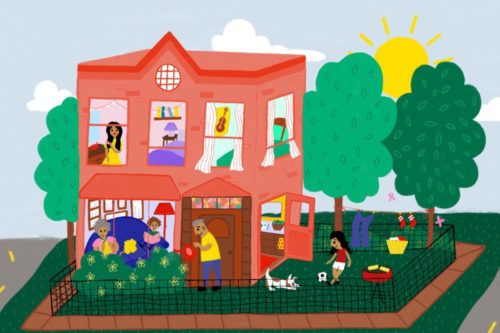
HUD’s $12.8 million grant requires sweat equity

Posted May 19, 2013 by terry

HUD - Housing & Urban Development

HUD’s  Self-Help Homeownership Opportunity Program (SHOP)  has a grant totaling $12.8 million and has extended the application deadline to July 15th. It calls for applicants to “contribute significant amounts of sweat equity.”  Right now, for many of us, sweat is what we have in abundance.

From HUD’s website:

SHOP awards grant funds to eligible national and regional non-profit organizations and consortia to purchase home sites and develop or improve the infrastructure needed to set the stage for sweat equity and volunteer-based home ownership programs for low-income persons and families. SHOP funds must be used for eligible expenses to develop decent, safe and sanitary non-luxury housing for low-income persons and families who otherwise would not become homeowners. Home buyers must be willing to contribute significant amounts of their own sweat equity toward the construction or rehabilitation of their homes.

Let’s go for this grant! Reading the fine print is not my strong suit but we’ve got nothing to lose and much to gain. If this interests you, please e-mail terry@newcommunityvision.coop

Syndicated from New Community Vision


Home sharing opportunities – finding or creating them

Posted May 9, 2013 by terry

The fertile soil of the economic collapse and housing crisis compels us to think about new ideas that, in fatter times, would have been unthinkable. The  distinction between the type of sharing and the type of ownership is important.

Shared arrangements could include

  • PH/H – Professional Homes managed by Professional Homemakers. The household pivots around the Homemaker who decides who lives there, the terms of their residency and ensures the smooth and harmonious functioning of the home. This would be a great job, which is not to say an easy one, for people who are natural at it, grandmothers for example. It also would provide income for people who currently don’t consider themselves employable. Professional Homes could be owned or rented.
  • N-FIG, Non-Familial, Inter-Generational home sharing. All adults are equal, either all renters or all owners.
  • Dormitory housing – A case can be made for dormitory living. Some people are well over their love affair with “stuff” and would welcome living a simpler lifestyle in a gracious environment with less responsibility. Dormitories would have private bedrooms, common living space and an arrangement for meals. A rental model.

Promising new ownership models

Cook County Land Bank Ordinance

In an exciting development, Cook County’s new Land Bank initiative was created to purchase vacant and foreclosed properties with the intent to demolish what can’t be saved, rehab what’s salvageable for return to the tax roll. This will work to end blight and stabilize neighborhoods.

Single Family Home Cooperatives

A movement toward single family home cooperatives is primed for a breakthrough. A single family home co-op would look like any other single family home, except for the invisible anxiety under the surface. This is how it would work:

A cooperative corporation forms to purchase single family homes in a geographically manageable area. The optimal number for economies of scale is 100. The co-op is responsible for the mortgage, taxes, insurance and maintenance. You purchase a membership in the co-op and pay a monthly fee, the carrying charge, which conveys the permanent right to live in your unit. As a member owner, you would be renting from yourself. The co-op, not  individual members, pays for repairs and maintenance. If the roof or the furnace goes, the co-op is responsible. The Cook County Land Bank may be a good source for potential inventory.

Obviously, these new initiatives have many moving parts that can fit together in interesting and unexpected ways. The best approach is to come to a Housing Mixer in your neighborhood to see what might fit together for you and your family.

Photo: Stock Exchange

Syndicated from New Community Vision


So, you think your grandma can’t get a job, huh?

Posted May 8, 2013 by terry

Professional Homemaker, aka Grandma
If you’ve had the privilege of living in a well managed home, you know that life is sweeter when dinner is on the table at 6:30 and you take leftovers for lunch.

We rarely acknowledge the financial, psychological and time saving benefits of living in a well organized, gracious home. Indeed, it was one of the complaints of the women’s movement in the 1970′s: homemaking is a skill, conveys tangible benefits, is grossly unrecognized and never compensated.

Professional Homes managed by Professional Homemakers elevates homemaking to its rightful place by recognizing and paying for the immeasurable benefit of living in a well ordered home. Many people have the art and science of homemaking down pat. Regrettably, others have no clue and many of those are teenagers raising children.

In a Professional Home, the emphasis is on creating a harmonious environment in which people choose to live together and agree to pay their fair share, do their fair share, be pleasant and to contribute, tangibly and intangibly,  to the well being of the household.

The Professional Homemaker is the fulcrum that makes this system work. She (or he) decides who lives there, the terms of their residency and oversees the smooth and harmonious functioning of the home. The Homemaker doesn’t have to do the chores (although they could) but does ensure that they get done.

This would be a great job, which is not to say an easy one, for people who are natural at it, grandmothers for example. It also would provide income for people who currently don’t consider themselves employable. Since food and lodging would obviously be included, even a modest income could be  meaningful.

Watch for future posts about the various categories – Homemaker, Professional Homemaker Apprentice and Certified Professional Homemaker – and the process for achieving this recognition.

Grandmas, and guys who enjoy homemaking, please DO apply.

Photo: Stock Exchange / Professional Homemaker, aka Grandma

Syndicated from New Community Vision


DIS(closure): Making the Fight for Schools

Posted May 7, 2013 by veronica
Fact: Since 2004, school closures that transfer students outside their immediate neighborhoods have resulted in spikes of violence, in and around elementary and high schoolsFact: In previous round of Chicago school closings, 65% of the teachers that were displaced were African American WomenFact: 80% of displaced students transferred to underperforming schoolsWhy is the district undertaking drastic changes with known bad outcomes and no good outcomes?

Join Stone Soup in a transformative dialogue on education and school closures in the City of Chicago.  Our guest will be Karen from Northside Action for Justice (founder of Uptown’s Uplift High School). Learn how the fight against school closures is connected to different struggles around Chicago and nationwide (racism, homophobia, labor, housing, mental health, sexism).
Location: Stone Soup Leland House,
1430 W. Leland
Time: 6:00pm Breaking Bread (Pot-luck)   
6:30pm Discussion
We will also discuss plans for “outreach with your neighbor day” and the 3 Day City Wide MARCH on May 18, 19, and 20. All are welcome. Please share with your networks.
Bring your good hearts, open mind, and creative spirits to the table! In faith, love, and action- Leland House
Additional Resources: Northside Action for Justice: http://www.actionforjustice.org/ The Color Of School ClosureS Infographic: http://blogs.edweek.org/edweek/District_Dossier/2013/04/school_closings.html Teachers for Social Justice (TSJ)’s School Closings Fact Sheets http://www.teachersforjustice.org/2013/03/school-closings-fact-sheets.html Chicago Board of Education website: http://www.cpsboe.org/home

Syndicated from Stone Soup Leland


DIS(closure): Making the Fight for Schools

Posted May 7, 2013 by veronica
Fact: Since 2004, school closures that transfer students outside their immediate neighborhoods have resulted in spikes of violence, in and around elementary and high schoolsFact: In previous round of Chicago school closings, 65% of the teachers that were displaced were African American WomenFact: 80% of displaced students transferred to underperforming schoolsWhy is the district undertaking drastic changes with known bad outcomes and no good outcomes?

Join Stone Soup in a transformative dialogue on education and school closures in the City of Chicago.  Our guest will be Karen from Northside Action for Justice (founder of Uptown’s Uplift High School). Learn how the fight against school closures is connected to different struggles around Chicago and nationwide (racism, homophobia, labor, housing, mental health, sexism).
Location: Stone Soup Leland House,
1430 W. Leland
Time: 6:00pm Breaking Bread (Pot-luck)   
6:30pm Discussion
We will also discuss plans for “outreach with your neighbor day” and the 3 Day City Wide MARCH on May 18, 19, and 20. All are welcome. Please share with your networks.
Bring your good hearts, open mind, and creative spirits to the table! In faith, love, and action- Leland House
Additional Resources: Northside Action for Justice: http://www.actionforjustice.org/ The Color Of School ClosureS Infographic: http://blogs.edweek.org/edweek/District_Dossier/2013/04/school_closings.html Teachers for Social Justice (TSJ)’s School Closings Fact Sheets http://www.teachersforjustice.org/2013/03/school-closings-fact-sheets.html Chicago Board of Education website: http://www.cpsboe.org/home

Syndicated from Stone Soup Leland


Housing Mixers & Worker Co-ops Address the Housing Crisis

Posted May 7, 2013 by terry

Dysfunctional families are one of our thorniest and most fundamental societal problems. If we stabilize the family culture, we have a shot at stabilizing society. Securing affordable housing is a major stress because today’s economics make new construction or rehabbing existing construction unaffordable for low and moderate-income people. Since affordable housing is not in the cards, some sort of shared housing is the next best thing.

After parsing this problem for years, I have distilled an idea into a template that could work in any community and, as a cooperative, could be scaled up quickly anywhere in the country. I envision two worker owned co-ops working side-by-side to offer services and support to people seeking safe, secure housing.

  • New Community Vision, a worker-owned co-op of trained facilitators would facilitate Housing Mixers, monthly gatherings, community-by-community where people come to learn about a range of home sharing options and meet others grappling with the same issue. As people gather monthly, they will meet others that they would like to see more of and some they would like to see less of. Over time, affinity groups may wish to form households.

  • A worker-owned co-op of licensed social service professionals (SSPs) would support this process by helping people evaluate their options, make wise choices and settle in a new place.

The process would include screening and vetting applicants who, when approved, would be entered in a database that functions as a clearing house of information. The database would include potential residents and housing that is currently available, housing groups that are forming and may have openings, and Professional Homemakers managing professional homes. On the premise that like heals like, this model would work with difficult populations such as veterans, disabled people and ex-offenders.

Mudding through this particularly wrenching period, our citizenry is wounded on many levels but valiantly struggling to cope. Our goal must be to get as many people as possible on a fast track to healing by offering workshops and retreats frequently, widely and affordably to create a culture of healing. A consumer owned co-op of alternative and traditional medicine as well as dentistry, available to those excluded from the medical-industrial complex is a compelling idea.

When we get past this time of astonishing social, political and economic change and the dust settles, our attitudes about everything, including money, will have shifted radically. With so unemployed and underemployed, work will have a different purpose and meaning, as will money. In the future, a 30-hour work week might become the new norm, an appealing thought.

This effort must be sustainable, without a crushing amount of work. In this scheme, the worker owners earn enough for an adequate lifestyle although no one gets rich.

As this is put into place, the demand for housing will be overwhelming. Applicants could apply online or by phone, for those who choose to be offline. If applying by phone, intake representatives, working from home could screen applicants establishing a human-to-human bond on the first phone call. With thousands of competent unemployed people, a virtual army could be trained quickly.

 Photo / Stock Exchange

Syndicated from New Community Vision


Range of Home Sharing Options

Posted May 5, 2013 by terry
Ben Earwicker Garrison Photography, Boise, ID www.garrisonphoto.org

Ben Earwicker
Garrison Photography, Boise, ID
www.garrisonphoto.org

We face many crises today — housing, food, nutrition, education, isolation, care for children, the elderly and health care. Improving our housing model could realistically ameliorate, to some extent, many of these challenges. Given the premise that our predominate housing model–single person / single family homes–may not be ideal for all demographic groups, New Community Vision facilitates Housing Mixers to promote alternative options that are appropriate and secure for the gamut of life stages, whether that is 20 and starting out or 80 and winding down. These alternatives include:

  • PH/H – Professional Homes managed by Professional Homemakers. The homemaker decides who lives there, the terms of their residency and ensures the smooth and harmonious functioning of the home. This would be a great job, which is not to say an easy one, for people who are natural at it, grandmothers for example. It also would provide income for people who currently don’t consider themselves employable.
  • N-FIG, Non-Familial, Inter-Generational home sharing. All adults are equal, either all renters or all owners.
  • Dormitory housing – A case can be made for dormitory living. Some people are well over their love affair with “stuff” and would welcome living a simpler lifestyle in a gracious environment with less responsibility. Dormitories would have private bedrooms, common living space and an arrangement for meals.
  • Re-purpose Big Box Stores and strip malls into charming, walkable villages. Carve up big box stores to a create courtyard surrounded by the building which has been re-purposed into apartments, shops, classrooms, and offices. The courtyard could be used for a playground, flower or vegetable gardens, outdoor amphitheater, aviary, fitness course or a slew of other ideas. 

Principles of successfully sharing a roof

Anyone sharing a roof with others would benefit by adhering to these principles:

  • People choose where to live. If it does not suit you, live elsewhere.
  • Everyone pays their fair share and does their fair share i.e., chores.
  • Be pleasant. If you can’t muster that, at least strive for it.
  • MYOB, mind your own business. Thou shalt not judge, meddle, or attempt to “fix” anyone.

Supportive Services

Living with others is not easy. Living alone isn’t either. A social service professional who knows the residents and functions as a housing coach would help the household to stay even-keeled. The coach would facilitate monthly “communications tune-ups” where household members discuss issues and air differences to prevent misunderstandings from festering into hardened resentments. The goal is to establish and maintain healthy boundaries and communication which are essential to successful living, particularly with others. Housing coaches would develop their own clients and fee arrangement with each household.

Syndicated from New Community Vision


Nurturing communities from the ground up

Posted May 2, 2013 by terry
photo: Arctic Cooperatives Limited/ Northern Manitoba, Canada

photo: Arctic Cooperatives Limited/ Northern Manitoba, Canada

Using break through technology, face-to-face neighboring, communities can strengthen themselves from the ground up, a potential game changer.

Community Mixers and Housing Mixers have the potential to empower communities to create housing, jobs, good food and strong communities from within. Every community is rich in resources – people who know how to fix things, nurses, early childhood experts, computer geeks, chefs, writers, grandparents and more. Communities that galvanize their resources to tackle their own problems will win.

A Cooperative Community Center for the Non-Rich

Be on the lookout for structurally sound, probably vacant, buildings  that need work. A suitable building, a collaborative landlord and alderman, where communities could meet for free at least once or twice a month for six months could provide the window of opportunity to generate momentum. A community that is motivated to write grants, get publicity, raise money, involve churches and neighborhood groups and make repairs has a good shot at creating durable, workable solutions.

Meeting in building that is currently vacant but has potential to be reclaimed and rehabbed as a community center would function as a fulcrum to leverage resources into a regenerative powerhouse: a cooperative community center for the non-rich. It would directly address the community’s needs, which could include a  computer lab, community diner, child care and/or elder care, ongoing workshops and classes. Most importantly, it could be a place to just be together without having to spend money, i.e. outside the consumption grid.

Cooperatively, member owned, operated and governed, and adhering to the Seven Cooperative Principles, the club could exist in an  enterprise zone beyond the talons of corporations that bleed communities dry.  Monsanto,  Koch Brothers entities, Wal-Mart and their privileged brethren need not apply.

New Community Vision facilitates Housing Mixers at the Lake Street Church of Evanston on the 4th Sunday of the month from 12 – 2 p.m. Lake Street Church is handicapped accessible and is three blocks from the Purple Line Dempster Street station.

Syndicated from New Community Vision


How Crazy is That – launch party postponed

Posted May 2, 2013 by terry
Buena Landmark Lobby

Buena Landmark Lobby

I am postponing the How Crazy is That? launch party because even after all this time, I’m still doing this mostly by myself in my spare time (none), with my spare cash (double none). I never intended my passion for community building as a solo effort and I welcome anyone who gets what this is about and wants to join me in this very exciting work.

The building where I live, a former apartment hotel, is an architectural gem. My apartment, the cutest smallest in the city has wonderful light, air and quiet. The privacy is wonderful and it’s perfect for getting a lot of work done but it’s about as social as a Red Roof Inn©.

Watch for the re-scheduled How Crazy is That? launch party and see for yourself. I look forward to seeing you there and to cooking up some cooperative solutions to our pressing challenges.

Syndicated from New Community Vision


From Reeling to Healing

Posted May 1, 2013 by terry
Photo Stock Exchange / Healthy little girl

Photo Stock Exchange / Healthy little girl

We’re all reeling from waves of shocks to our sensibilities – Hurricane Sandy, Newtown, the sequester, Boston, West, Texas and floods. With hardly time to get up and dust ourselves off between hits, I am in a lot of wobbly company. When we get up, it is to weep for the environment, our poor and ill people and the imploded economy.

Strength in Numbers

Hanging out together, casually and socially, outside of the consumption grid, is an antidote to the despair that any thinking person must feel as we watch the economy and the environment deteriorate in front of our eyes. Community Mixers and Housing Mixers are a good way to create the familiarity that creates the trust that leads to the laughter that builds community.

By hosting frequent mixers outside of the consumption grid, we provide the occasions for communities to gather casually and often to meet people, make connections, and learn how co-ops can deliver the goods, services and housing that we need. These gatherings are the fertile compost that fosters a healthy, interdependent community spirit in which people thrive.

Cooperatively this is possible AND highly beneficial. New Community Vision is pioneering Mixers community-by-community to do just that.

  • Community Mixers – monthly potlucks with music and just plain fun
  • Housing Mixers – monthly gatherings to consider a range of housing options. There are a variety of options for sharing – all with varying degrees of privacy, ranging from single family home to shared apartments.

By hosting frequent mixers outside of the consumption grid, we provide the occasions for communities to gather casually and often to meet people, make connections, and learn how co-ops can deliver the goods, services and housing that we need. These gatherings are the fertile compost that fosters a healthy, interdependent community spirit in which people matter and thrive. 

New Community Vision facilitates Housing Mixers on the fourth Sunday of every month from noon to 2 p.m. at the Lake Street Church of Evanston.

Syndicated from New Community Vision